How Much Money Do You Need for One Week in Georgia? A Practical Travel Budget Guide
Planning a one-week trip to Georgia and wondering how much money to bring? This is one of the most common questions before a first journey to the Caucasus — and for a good reason. Although Georgia is still relatively affordable for many travellers from Europe, costs can vary a lot depending on your travel style.
The budget will look different for someone travelling by marshrutkas, staying in simple guesthouses and eating in local cafés. It will be different for a family looking for comfortable transport, private drivers, good restaurants and reliable accommodation. And different again for a couple planning a slower trip with wine tastings, better hotels and less improvisation.
The good news is simple: Georgia can still be travelled on a reasonable budget. You just need to know where it makes sense to save money — and where it really does not.
Is Georgia an expensive country?
For travellers from Poland and many other European countries, Georgia is usually not an expensive destination, especially compared with Western Europe, popular holiday islands or large tourist cities.
Food in local restaurants, public transport, marshrutkas, wine and many simple guesthouses can still be very affordable. This is one of the reasons why Georgia is such an attractive destination for a one-week trip.
But it is worth saying honestly: Georgia is no longer “very cheap” in every situation. In popular places such as Tbilisi, Kazbegi, Batumi or well-known wineries in Kakheti, prices have increased in recent years. Better hotels, private transport, good restaurants and tourist experiences can cost noticeably more than they used to.
In simple terms:
Georgia can be inexpensive if you travel simply. It can be moderately priced if you want comfort. And it can become expensive if you choose higher-standard accommodation and private services.
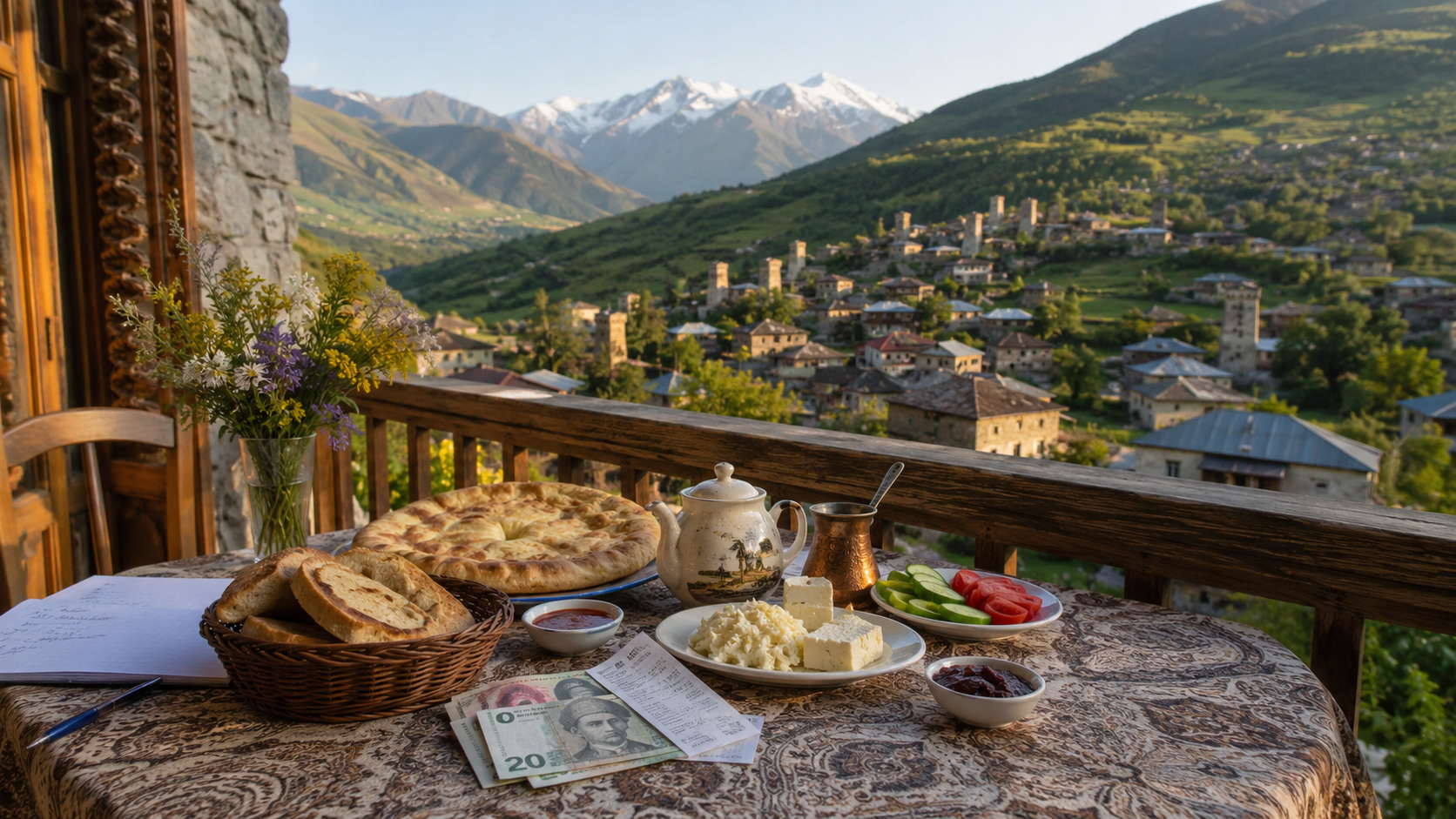
Georgian currency — what do you pay with?
The currency in Georgia is the Georgian lari, or GEL. This is what you will use locally for food, accommodation, transport, entrance tickets and shopping.
In larger cities, hotels, restaurants and shops, card payments are widely accepted. However, it is still useful to have cash with you, especially if you plan to travel outside Tbilisi, visit local markets, use marshrutkas, buy small items, leave tips or pay in family-run places.
It is usually not a good idea to exchange your entire budget at the airport. Exchange rates there are often less favourable. A better option is to bring euros or US dollars and exchange money locally in a currency exchange office. In Tbilisi, Kutaisi, Batumi or Telavi, exchange offices are easy to find.
How much money should you bring to Georgia for one week?
It depends on your travel style, but you can think about three general budget levels.
Budget travel: around 250–350 EUR per person per week
This option is for travellers who keep things simple and organise most of the trip themselves. They stay in hostels or basic guesthouses, eat mainly in local places, travel by marshrutkas and do not plan many paid activities.
With this budget, you should expect less comfort, simpler accommodation and more self-organisation.
It can work well for backpackers, students or travellers who enjoy flexible, low-cost travel.
Mid-range travel: around 450–700 EUR per person per week
This is the most realistic budget for many travellers who want to travel comfortably, but without luxury.
With this amount, you can plan decent accommodation, meals in good local restaurants, some taxis or private transfers, entrance tickets, wine tastings and a few souvenirs.
This is a good level for couples, families and travellers who do not want to count every coin, but still want to keep their spending under control.
Comfortable travel: from 800 EUR per person per week and up
If you want private transport, better hotels, good restaurants, tastings in trusted wineries, a guide, less chaos and more comfort, the budget will be higher.
Georgia can offer a very beautiful and comfortable journey, but then it is better not to assume that the whole trip will be “super cheap”. Private services, a good driver, reliable accommodation and a well-designed itinerary all have their price.
This option is for travellers who prefer to pay more, but do not want to waste time looking for transport, making random decisions or wondering whether a place is really worth visiting.
How much does food cost in Georgia?
Food is one of the greatest pleasures of travelling in Georgia — and one of the things you should not save too much on.
In a local restaurant, you can eat very well for a reasonable price. Khachapuri, khinkali, lobio, eggplant with walnut paste, local cheese, homemade bread or a glass of wine are still more affordable than in many European countries.
As a rough guide:
simple meal in a local place: around 20–35 GEL per person
solid lunch or dinner in a good restaurant: around 40–70 GEL per person
larger dinner with wine: around 80–120 GEL or more per person
Of course, everything depends on the place. A small local café will be cheaper. A restaurant in central Tbilisi, a popular place in Kazbegi or an elegant winery will cost more.
If you want to eat well and comfortably, it is reasonable to plan around 25–40 EUR per person per day for food and drinks. You can do it cheaper, of course, but Georgia tastes best when you do not have to choose only the cheapest option.
How much does accommodation cost in Georgia?
Accommodation in Georgia varies a lot. You can find simple hostels, family-run guesthouses, small hotels, boutique hotels and more and more higher-standard places.
As a rough guide:
hostel or very simple room: from around 50–80 GEL per night
guesthouse or small family hotel: around 100–200 GEL per room
good 3–4 star hotel: from around 250 GEL and up
boutique hotels and higher-standard stays: significantly more, especially in high season
It is worth remembering that family guesthouses in Georgia often offer something even the best hotel cannot: contact with hosts, a homely atmosphere and breakfasts that can easily keep you full for half a day of sightseeing.
At the same time, the cheapest accommodation is not always the best choice. Location, cleanliness, heating in winter or air conditioning in summer, a comfortable bed and a proper bathroom really matter — especially if your trip lasts a week or longer.
How much does transport cost in Georgia?
Transport is the category where budget differences can be the biggest.
The cheapest option is the marshrutka, a local minibus. Marshrutkas are inexpensive and reach many places, but they are not always the most comfortable. Schedules can be flexible, journeys may take longer than expected, and the standard depends on the vehicle.
In Tbilisi, there is a metro system, buses and taxis. Public transport is cheap, and taxi apps are convenient for short city rides.
However, if you want to explore regions, wineries, monasteries, mountains and places located away from main routes, private transport or car rental can be much more comfortable.
As a rough guide:
metro/bus in Tbilisi: very cheap
short taxi ride in the city: often a few to a dozen GEL, depending on distance
marshrutkas between towns: usually inexpensive
car rental: from several dozen EUR per day, more for a 4×4
private driver for a day trip: depends on the route, season and type of car
In Georgia, the cheapest transport is not always the best choice. Mountain roads, long drives, local driving style and distances between attractions can be tiring. Sometimes paying more for a good driver is not a luxury — it is simply a calmer and safer way to travel.
How much do attractions, tastings and entrance tickets cost?
Many beautiful places in Georgia can be visited without major fees. Viewpoints, old towns, churches, monasteries and local markets often do not require a large budget.
You may need to pay for museums, some historical complexes, wine tastings, cooking workshops, jeep rides, mountain lifts, local guides or special experiences.
It is a good idea to plan an additional 100–200 EUR per person per week for entrance tickets, tastings, small activities and souvenirs. If you want to visit more wineries, take part in workshops or book private experiences, prepare a higher budget.
Cash or card?
The best answer is: both.
You can pay by card in many restaurants, hotels, shops and larger tourist facilities. Cash is useful at markets, in small towns, for local products, marshrutkas, tips and small family-run places.
A good solution is to keep part of your money on a card and part in cash. You do not need to carry your entire weekly budget with you, but it is good to have some lari for situations when the card terminal suddenly “does not work” — or simply does not exist.
What should you not save money on in Georgia?
There are a few things where saving too much is not a good idea.
First: transport in the mountains. A good car and driver really matter.
Second: food. Georgian cuisine is one of the most important parts of the journey, so it would be a pity to spend the whole week eating only the cheapest snacks.
Third: a well-planned itinerary. In Georgia, it is easy to lose time because of an overly ambitious route, poor connections, underestimated distances or random accommodation.
Fourth: good local experiences — a wine tasting, a meeting with a host, a cooking workshop or a visit to a place with real history.
These are often the things you remember the longest.
So, how much money do you really need for one week in Georgia?
For most travellers, a reasonable estimate would be:
minimum: 250–350 EUR per person if you travel very economically
comfortable mid-range: 450–700 EUR per person if you want good food, decent accommodation and paid activities
more comfortable: from 800 EUR per person and up if you want private transport, better hotels and smoother organisation
Of course, this does not include flights, travel insurance or the cost of a ready-made tour if you are not organising everything yourself.
Georgia can be affordable — but it does not have to be “budget”
The biggest mistake is thinking of Georgia only as a cheap destination. Yes, you can still travel here on a low budget. But Georgia can also be comfortable, well-organised and high-quality — if the trip is planned properly.
The most important thing is to match your budget with your expectations. If you want to move around cheaply and improvise, it is possible. If you want a stress-free journey with good places, a sensible pace and local context, it is worth planning a higher budget.
At Georgia Uncovered, we help design trips where money is spent wisely: not on random attractions, not on poorly chosen accommodation and not on routes that look good only on a map.
Because in Georgia, the point is not to spend as little as possible. The point is to come back feeling that it was truly worth it.